What is the Life Expectancy of CKD Patients?
The life expectancy of CKD patients ranges anywhere from 5 to over 30 years, depending heavily on the stage at diagnosis, your age, and how proactively you manage your overall health. While early stages often have a minimal impact on your natural lifespan, even advanced stages can be managed for years with modern treatments, lifestyle tweaks, and proper medical guidance.
If you or a loved one recently opened a lab report, saw the words "Chronic Kidney Disease," and immediately fell down a late-night internet search rabbit hole, take a deep breath. It is completely normal for your heart to sink into your stomach when you read cold, clinical statistics online. But here is the secret that medical charts often forget to mention: you are an individual human being with a unique body, not a static data point in a textbook.
Statisticians calculate averages by looking backward at massive populations, but your personal health story moves forward based on what you do today. Let’s strip away the overwhelming medical jargon, look at what the science actually says, and break down what chronic kidney disease life expectancy means for real people living real lives.
Understanding CKD: Why the Stages Matter
Your kidneys are basically your body’s internal recycling and filtration plant. They work 24/7, quietly filtering out waste, balancing fluids, and keeping your blood pressure steady without asking for a thank-you note. When you have chronic kidney disease, these bean-shaped bean-cleaners have suffered some wear and tear, reducing their efficiency over time.
To figure out how your kidneys are doing, doctors look at your eGFR levels (estimated Glomerular Filtration Rate), which is essentially a score from 0 to 100+ that rates how well your kidneys filter blood.
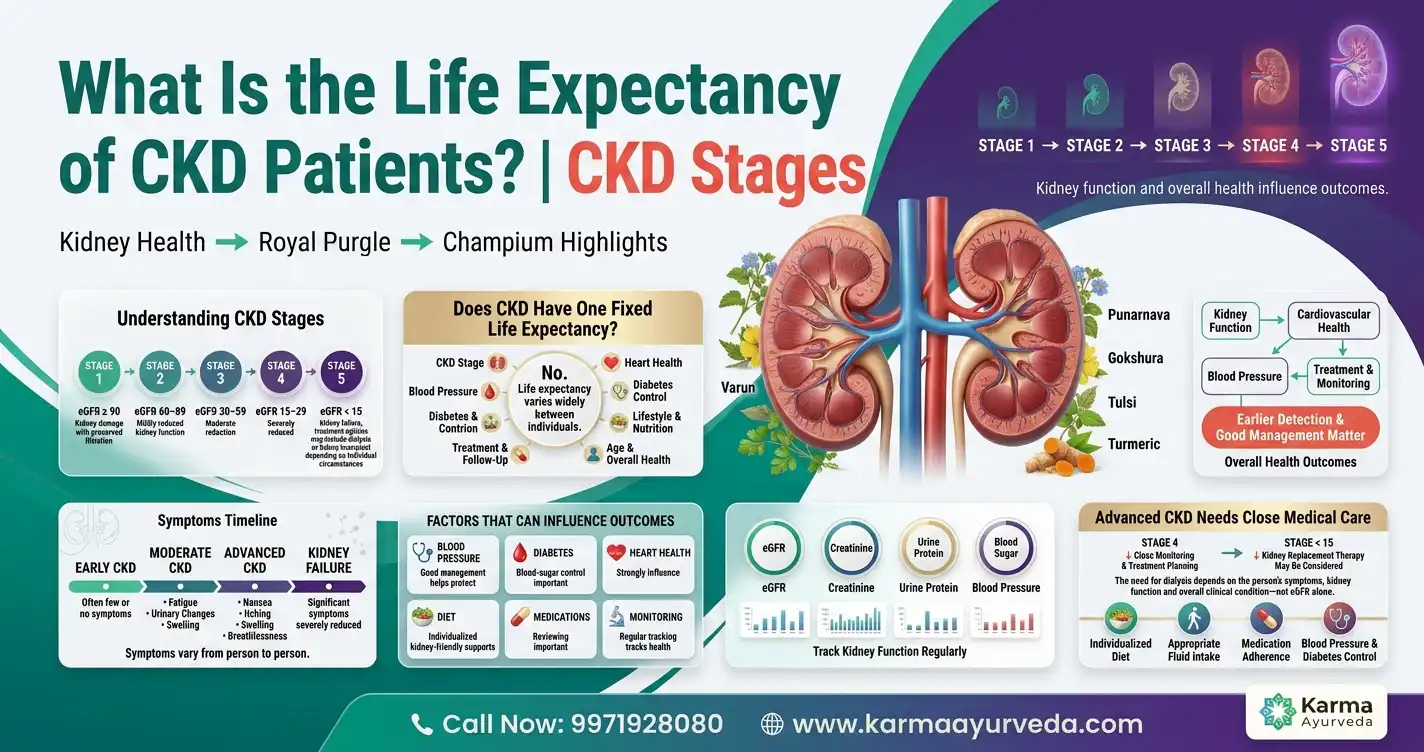
Based on this score, CKD stages are broken down into five levels:
- Stage 1 (eGFR 90+): Mild kidney damage, but your kidneys are still working at top speed.
- Stage 2 (eGFR 60–89): Mild reduction in function. Most people feel completely fine and have no symptoms.
- Stage 3a & 3b (eGFR 30–59): Moderate reduction in function. This is often the stage where people get diagnosed during routine bloodwork.
- Stage 4 (eGFR 15–29): Severe reduction in function. Your body is starting to feel the strain, and it's time to prepare for advanced treatments.
- Stage 5 (eGFR below 15): Kidney failure life expectancy territory (End-Stage Renal Disease or ESRD), where filtering assistance like dialysis or a transplant is needed.
What Do the Numbers Actually Say? (By Stage and Age)
When researchers analyze large cohorts, such as those tracked in the United States Renal Data System (USRDS) Annual Data Report, they map out average survival estimates across different age groups and stages.
Early Stages (Stages 1 and 2)
In Stages 1 and 2, your kidney disease prognosis is remarkably optimistic. For instance, a 30-year-old diagnosed with Stage 2 CKD still has an average life expectancy of around 39 to 44 years. If you are diagnosed in your 60s at Stage 1 or 2, study data from the National Kidney Foundation shows that your average remaining life expectancy is virtually identical to someone without CKD of the exact same age—roughly 15 to 18 years.
Middle Stage (Stage 3)
Stage 3 is the most common turning point. A multi-study survey published in major nephrology reviews on stage 3 kidney disease life expectancy revealed an encouraging fact: the majority of people with Stage 3 CKD actually never progress to Stage 4 or kidney failure. Instead, with modest dietary adjustments and blood pressure control, their kidney function stabilizes for decades. For a 60-year-old, average life expectancy at Stage 3 sits between 11 and 13 years, but proactive health management frequently stretches those numbers further.
Advanced Stages (Stages 4 and 5)
In Stage 4, life expectancy averages around 6 to 8 years for a 60-year-old, while Stage 5 without dialysis drops significantly. However, entering Stage 5 is not the end of the line—it is the start of a new treatment phase. According to the National Kidney Foundation, the average dialysis life expectancy is 5 to 10 years, but many patients live active, fulfilling lives on dialysis for 15 to 20 years or more. Furthermore, receiving a kidney transplant can nearly double that outlook compared to staying on long-term dialysis.
CKD Stage & Life Expectancy Quick Comparison
To make these complex medical statistics easier to scan, here is a quick breakdown of how stages generally map out in the medical literature:
Stage 1 — eGFR Range: 90 or higher — Kidney Function: 90%–100% — Minimal to None. You’ll likely die of old age long before your kidneys give up.
Stage 2 — eGFR Range: 60–89 — Kidney Function: 60%–89% — Very Low. Mild wear and tear. Mostly requires keeping blood pressure in check.
Stage 3 — eGFR Range: 30–59 — Kidney Function: 30%–59% — Moderate. Most people stay here forever without ever reaching failure.
Stage 4 — eGFR Range: 15–29 — Kidney Function: 15%–29% — Significant. Time to work closely with a nephrologist and plan ahead.
Stage 5 — eGFR Range: Under 15 — Kidney Function: Less than 15% — Severe. Requires dialysis or a transplant, which restores long-term vitality.
How to Outsmart the Averages: Slowing CKD Progression
Statistics tell you what happened to thousands of strangers in the past; they do not dictate your future. You have immense power over slowing CKD progression through daily choices and clinical partnerships.
Here are the most effective ways to protect your remaining kidney function:
- Tame Your Blood Pressure: High blood pressure acts like a pressure washer inside your kidney's delicate blood vessels. Keeping it below target levels (often around 120/80 mmHg) is the single best way to preserve eGFR.
- Manage Blood Sugar: Diabetes is the leading cause of kidney damage worldwide. Keeping your HbA1c levels stable prevents sugar from damaging tiny kidney filters.
- Rethink Pain Management: Over-the-counter NSAIDs like ibuprofen and naproxen can be surprisingly harsh on your kidneys. Swap them for kidney-friendly alternatives recommended by your doctor.
- Adopt a Kidney-Smart Diet: Reducing excessive sodium intake takes the workload off your kidneys. Depending on your stage, adjusting protein, potassium, and phosphorus intake can make a massive difference.
- Ask About Modern Medications: Clinical breakthroughs like SGLT2 inhibitors and ACE inhibitors/ARBs have revolutionized nephrology, slowing down kidney decline significantly even in late stages.
What Science Says: Groundbreaking Studies Giving Hope
If you read old medical articles, you might think a CKD diagnosis is a ticking clock. But medical research moves fast, and recent landmark clinical trials show that the outlook is brighter than ever.
- The EMPA-KIDNEY Trial (2023): This landmark study published in The New England Journal of Medicine evaluated thousands of CKD patients and found that SGLT2 inhibitor medications reduced the risk of kidney disease progression or cardiovascular death by a massive 28%.
- The USRDS 2024 Annual Data Report: Updated surveillance data confirms that overall survival rates for individuals with kidney disease have stabilized and improved significantly as early screening for high-risk patients becomes standard practice.
- The DAPA-CKD Study: A trial demonstrating that targeted pharmaceutical interventions can preserve years of kidney life, allowing people in Stage 3 or 4 to stay off dialysis for significantly longer periods than was possible a decade ago.
Key Takeaways
- Stages 1 to 3 have strong survival rates: Most people diagnosed in early stages live normal, full lifespans with minimal complications.
- Stage 3 rarely leads to total failure: The majority of Stage 3 patients stabilize and never progress to end-stage renal disease.
- Dialysis and transplants save lives: Stage 5 is manageable, with average dialysis survival of 5–10 years and transplants offering decades more.
- Lifestyle directly alters statistics: Controlling blood pressure, managing blood sugar, avoiding NSAIDs, and eating smart preserves kidney function.
- You are not a statistic: Individual health, medical adherence, and positive habits matter far more than demographic averages.
Frequently Asked Questions
Can you live a normal life span with stage 3 CKD?
Yes, most people with stage 3 CKD live a normal, full lifespan because the disease often stabilizes and never progresses to kidney failure.
Does stage 1 or 2 CKD shorten your life expectancy?
Stage 1 and 2 CKD generally do not shorten your life expectancy if you keep your blood pressure and overall health well-managed.
What is the average life expectancy for someone on kidney dialysis?
The average life expectancy on dialysis is 5 to 10 years, though many patients live active lives on dialysis for 15 to 20 years or more.
Can diet and lifestyle slow down the progression of CKD?
Yes, adopting a low-sodium diet, controlling blood sugar, staying active, and avoiding kidney-damaging pain medications significantly slow down CKD progression.
Is a kidney transplant better for life expectancy than dialysis?
Yes, a kidney transplant typically doubles a patient's life expectancy compared to remaining on long-term dialysis while drastically improving overall quality of life.
Medical Disclaimer
This blog post is for informational and educational purposes only and should not be taken as professional medical advice. Always consult with a qualified healthcare provider or nephrologist regarding any medical condition, diagnosis, or treatment plan tailored to your specific personal health needs.
Continue using AI Cursor?Keep it onTurn Off