
Can Ayurveda Support Kidney Function in CKD? A Case Report Shares Encouraging Results
Today I'm sharing something I came across about Ayurveda and kidney health. It comes from a research case report, and I'll walk you through it in plain words.
Chronic Kidney Disease (CKD) is a condition in which the kidneys lose their strength little by little. Our kidneys act like cleaners for the body. They throw out waste and extra water, so when they get damaged, our overall health suffers. Diabetes and high blood pressure are the two biggest causes.
This report appeared in the Journal of Ayurveda & Holistic Medicine in December 2023. Its authors are Poonam Dang, Sakshi Badyal, Puneet Dhawan, and H. S. Tiwari. It tells the story of a 45-year-old man with CKD who followed an Ayurvedic treatment plan. Within four months, his serum creatinine fell sharply, and a few of his symptoms eased as well.
Let's see what really happened!
What Is Chronic Kidney Disease?
CKD means the kidneys get harmed gradually over a long time. The harm affects the nephrons, the very small filters inside the kidneys. As more nephrons stop working, the kidneys become less able to clean the blood.
Doctors sort CKD into five stages using a measure called GFR (Glomerular Filtration Rate). It shows how well the kidneys filter the blood. A lower GFR means a more serious kidney problem.
Some common causes and risk factors are:
- Diabetes and high blood pressure
- Polycystic Kidney Disease
- Certain immune system disorders
- Frequent kidney infections or kidney stones
- Taking some medicines (such as certain painkillers) for many years
- Older age or a family history of kidney disease
In the beginning, CKD often shows no obvious signs. As it advances, a person may feel worn out, notice swollen feet, feel nauseous, lose interest in food, suffer from itching or anemia, or see changes in their urine.
The Patient's Story
The patient was a 45-year-old man from Assam. In January 2023, he reached out to Karma Ayurveda for an online consultation.
He had lived with diabetes for roughly 20 years and with high blood pressure for 4 years. For about two months, he had also been dealing with constipation, tiredness, and swelling in his feet.
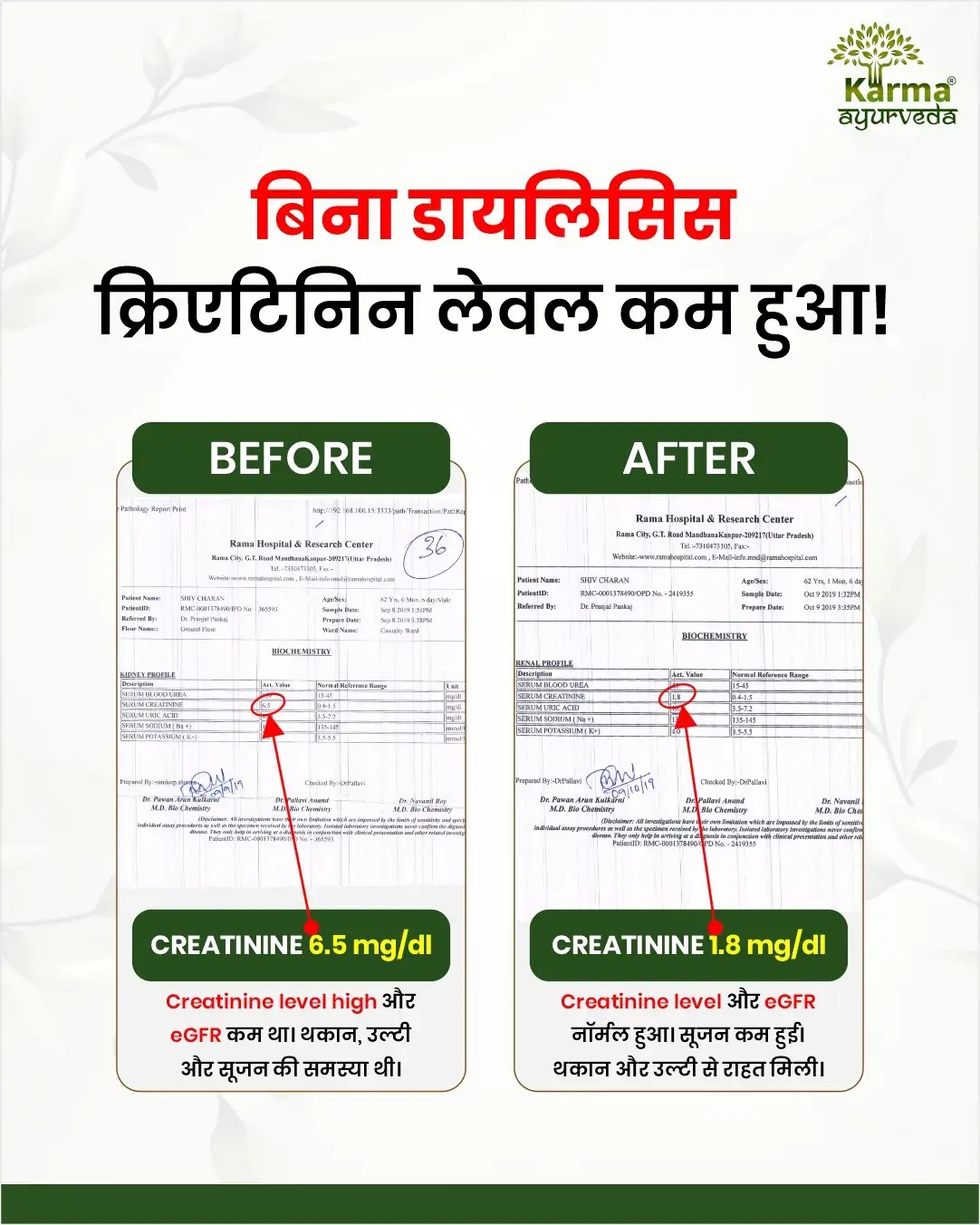
A blood test on January 19, 2023 showed his serum creatinine at 3.6 mg/dL. Creatinine is a waste substance produced by our muscles. When the kidneys are healthy, they remove it through urine. When they are weak, it collects in the blood. This is why doctors use serum creatinine to judge kidney health.
He had also been smoking and drinking alcohol regularly for six years. During the check-up, the doctors noticed swollen legs and a coated tongue.
The Treatment
After examining him, the Ayurvedic team prepared a plan of herbal medicines and diet changes, which he followed for four months. The medicines were:
- Ren Plus Ultra Kwatha Churna: 10 grams before meals
- Renal Plus Tablets: Two 400 mg tablets, three times a day after meals
- Arka Nephrowin: 20 ml twice a day, mixed with an equal amount of water, after meals
- SPGV Tablets: Two 250 mg tablets, twice a day after meals
- DOD Kadha: 10 grams twice a day before meals
He was also advised to stay away from milk and milk products, and from vegetables such as cabbage, spinach, and brinjal. The entire plan was designed around his kidney condition, diabetes, and high blood pressure.
How Did the Herbs Help?
As the paper explains, each herb had a specific role.
1. Gokshura: This was a key herb in Renal Plus. According to the paper, it has rejuvenating qualities, encourages the flow of urine, and may help bring down serum creatinine.
2. Punarnava and Shatavari: These were included for their rejuvenating effect. The paper says they may nourish the kidney tissues and help keep them in better shape. It also refers to earlier studies hinting that Shatavari may help lower creatinine.
3. Trina Panchamoola: This blend was part of Ren Plus Ultra Kwatha. It may support the kidneys and the flow of urine. It also has antioxidant action, which may shield the body from harm caused by free radicals (unstable, harmful molecules).
4. Gudmar, Karela, and other herbs: Because the patient had been diabetic for 20 years, DOD Kadha was added. It contained Gudmar, Karela, Neem, Jamun, and Guduchi, which the paper says may help keep blood sugar in a healthy range.
5. Sarpagandha: To handle his high blood pressure, the SPGV tablets contained Sarpagandha. Its active compound, reserpine, is known for lowering blood pressure.
So the plan didn't focus on the kidneys alone. It also addressed his other health issues.
What Happened After Four Months?
The most notable result was the drop in his creatinine level.
- Before treatment: 3.6 mg/dL (January 19, 2023)
- After four months: 0.61 mg/dL
His constipation, tiredness, and swollen feet also improved. These were very hopeful results, and they were the key findings of the report.
How Does Ayurveda View Kidney Problems?
In Ayurveda, kidney problems are classed as Mutravaha Srotas Vikar, meaning disorders of the urinary system.
Ayurveda holds that CKD can develop when the three Doshas (Vata, Pitta, and Kapha) fall out of balance. The paper puts special focus on Vata imbalance, poor digestion, and blocked tiny channels in the body.
For this reason, Ayurvedic treatment aims at:
- Strengthening digestion and the way the body uses nutrients
- Bringing the three Doshas back into balance
- Helping urine flow normally
- Clearing out excess salt and water from the body
- Using rejuvenating herbs to nourish the body's tissues
So, What Can We Take Away?
This case report suggests that Ayurvedic treatment may be useful in managing CKD. After four months, the patient's creatinine fell considerably, and his constipation, tiredness, and swelling got better.