PSA Test: What Is It and When Is It Used?
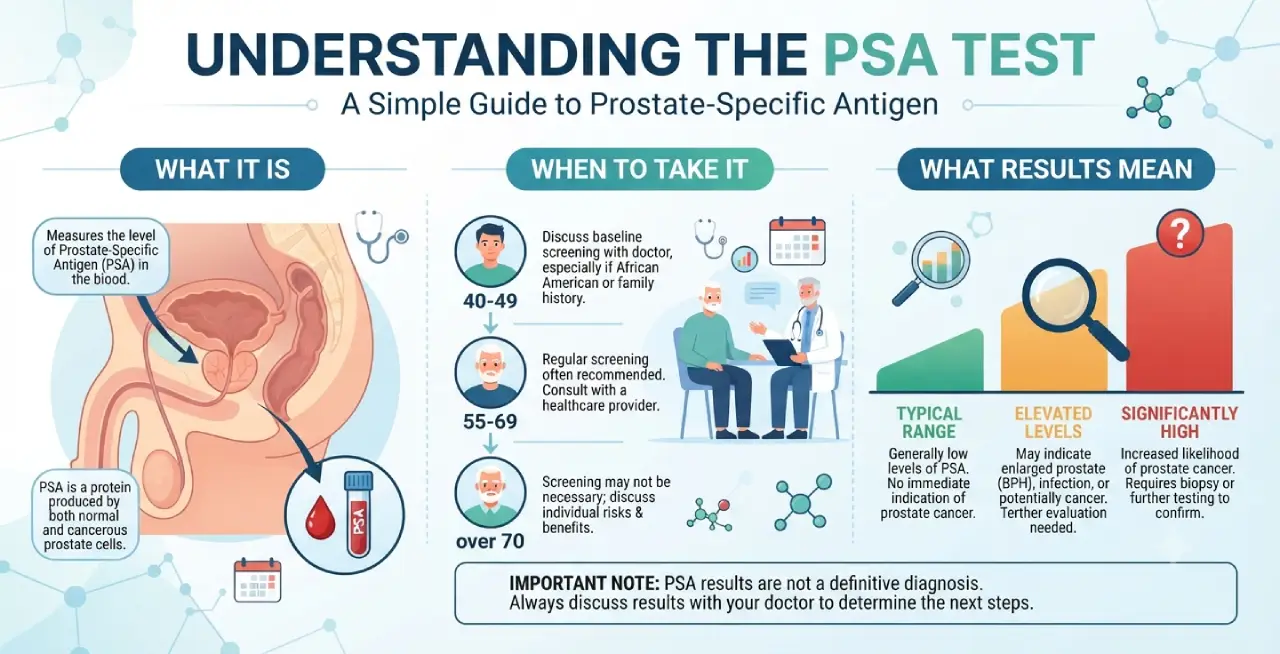
It is a simple blood test which measures prostate-specific antigen, the protein produced in the prostate gland. Doctors usually prescribe this test to men from around age of 50 (or earlier in case of the higher risk) or if symptoms related to urinating appear. It is only a preliminary screening test and not a conclusive diagnosis.
However, we should consider the other sides of the coin.
What Is PSA Anyway?
The prostate is a small, walnut-sized gland located below the bladder. This gland produces PSA and a small amount of PSA usually enters the blood. The higher level of PSA may indicate some problems, such as prostate enlargement or infection, or prostate cancer. However, high PSA level does not necessarily mean that the person has prostate cancer and normal PSA level does not mean that he/she will not have it in the future.
When to Take the PSA Test
This is the important part; when to go for PSA test depends on your age, family history, and other symptoms you experience:
- At around 50: Typical time when healthy men usually start discussing prostate cancer screening with doctors
- Around 45 years old: If you have a father or brothers with prostate cancer.
- Approximately 40-45 for men with risk factors, such as those of African ancestry, as recommended by the American Cancer Society.
- Any age: If you notice difficulties with urinating, poor stream of urine, frequent night urination, or blood in urine or semen.
The European Association of Urology and the American Urological Association insist on the use of shared decision-making, which means talking about the pros and cons of a procedure before undergoing it.
Research Findings
Several large-scale studies have influenced this discussion. For example, the European Randomized Study of Screening for Prostate Cancer (Hugosson et al., 2019, European Urology) has demonstrated that screening for prostate cancer reduced the mortality due to this disease. On the other hand, the US PLCO trial (Andriole et al., 2009, New England Journal of Medicine) did not find any significant benefits of screening in terms of prostate cancer mortality. However, it is worth noting that in the case of the PLCO trial, some men in the control group were screened for prostate cancer outside the study.
Translation: researchers still have arguments, which is why your own position matters more than the universal rule. There is concern about overdiagnosis, as there are some slow growing tumors that do not cause harm.
What Can Nudge Your PSA Number?
Before panic over the test results you should know that there are many things which may cause them to go down.
- Urinary infection or prostatitis
- Recent ejaculation, cycling or prostate exam
- An enlarged prostate (BPH)
- Certain procedures like catheterization
A useful tip to follow is to avoid your triggers for some days before your exam. Make sure to check with your doctor to find out the specific recommendation.
Quick Comparison
| PSA test | Digital rectal exam |
|---|---|
| What it is | A blood sample |
| Comfort level | A little bit of discomfort |
| Role | Possible trouble |
What Comes Next to Abnormal Results?
High results mean repeating the test, and possibly an MRI or even a biopsy. However, the results of PROMIS study (Ahmed et al., 2017, The Lancet) show that the multiparametric MRI allows to avoid unnecessary biopsies in many men. Thus, the high level is the beginning of discussion, not the problem.
Home Tips for Cancer Support
Though some home remedies will not replace medical care, home tips for cancer can be used as an additional measure:
- Staying at a healthy weight and being active
- Eating lots of vegetables, fruits, and whole grains
- Limiting consumption of processed meats and alcohol
- Not smoking
- Having regular medical examinations
How Ayurveda fits into practice
In some cases, people try to get help from Ayurveda for energy and for improving digestion and general health. Among such herbs, Ashwagandha, turmeric and Guduchi are often mentioned when people search for best herbs for cancer treatment in Ayurveda, but the results obtained through laboratory experiments have not been confirmed by human trials and they can interfere with the chemotherapy. Thus, everything has to be discussed with your oncologist.
Dr. Puneet Dhawan, who is the fifth-generation Ayurvedic practitioner in Delhi, is the name which people consider when it comes to consultations which combine the concepts of Western and Ayurvedic medicine.
Additional thoughts
It must be noted that the PSA test is quite a handy but imperfect tool, which may mislead if we don't take it into consideration with context of other factors. Discuss the possible alternative of Karma Ayurveda for cancer treatment with your oncologist to get the best and most comprehensive treatment possible. Any cancer Ayurvedic treatment should also be discussed with the treating medical team, especially when standard cancer treatment is being used.
FAQs
What is a normal PSA level?
Many labs treat under 4 ng/mL as typical, but age and context matter.
Does a high PSA mean cancer?
Not necessarily, plenty of non-cancer causes can bump it up.
Do I need to fast for a PSA test?
Usually no, but ask your lab for their instructions.
How often should the test be repeated?
Your doctor will decide, often every 1 to 2 years depending on your result.
Can herbs lower PSA safely?
Evidence is limited, so don't self-treat without medical advice.
Disclaimer
This blog is for general information only and isn't a substitute for professional medical advice, diagnosis or treatment. Screening decisions vary by age, family history and health status. Please consult a qualified doctor or oncologist before testing, treatment changes, or starting any herbal or Ayurvedic supplement.