Unlocking Wellness Naturally
100% Ayurvedic Treatment

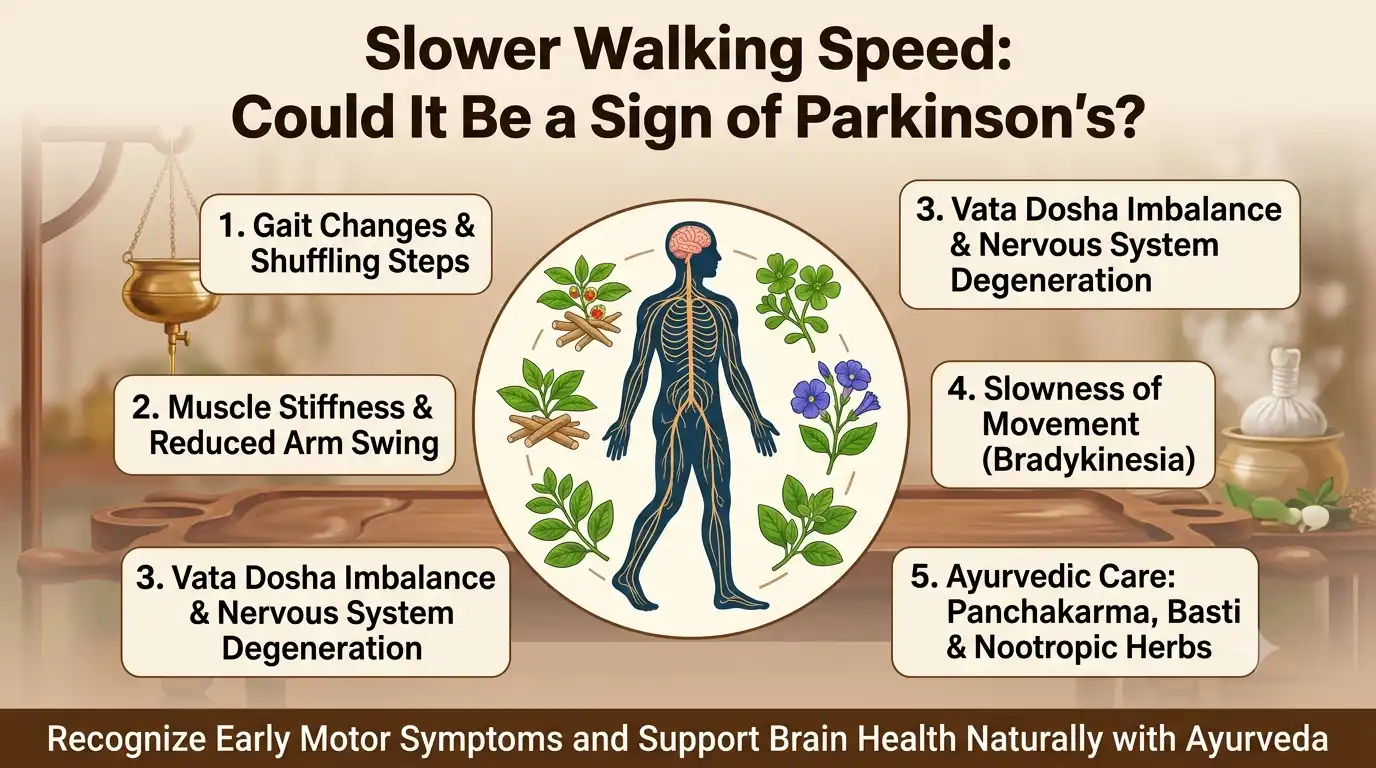
Yes, slower walking speed can be an early sign of Parkinson’s, particularly when it comes with smaller steps, reduced arm swing, stiffness, balance problems, or other movement changes. But walking slowly by itself does not mean someone has Parkinson’s disease.
Maybe you have noticed that someone who once walked briskly now seems to take shorter steps and move more cautiously. It is easy to blame age, tiredness, or “bas ab speed nahi rahi.” Sometimes that is exactly what it is. But when the change is persistent and comes with other symptoms, it deserves a closer look.
Parkinson’s disease is a neurological condition that affects movement. One of the important changes involves dopamine-producing nerve cells in an area of the brain called the substantia nigra. Dopamine helps the brain coordinate smooth, purposeful movement.
When dopamine signalling is affected, everyday movements can gradually become less automatic.
Walking is a good example. You may not consciously think about every step you take. Your brain simply handles it. With Parkinson’s, that automaticity can become less efficient.
This may lead to:
This slowing of movement is called bradykinesia, one of the major motor features associated with Parkinson’s.
No; and this is an important point.
Walking speed can decrease for plenty of ordinary reasons. Age-related muscle loss, arthritis, previous injuries, poor eyesight, lack of physical activity, balance concerns, certain medications, and other neurological or musculoskeletal conditions can all change the way someone walks.
So, please don't perform the classic internet diagnosis:
“My walking is slower → I have Parkinson’s.”
The human body is considerably more complicated than that.
Research has nevertheless found an interesting connection between walking performance and Parkinsonian changes. A study published in Movement Disorders examined gait characteristics in people with Parkinson’s and highlighted reduced walking speed, shorter stride length and altered gait patterns among commonly observed features.
Another important area of research is the Parkinson’s Progression Markers Initiative (PPMI), which has helped researchers investigate early biological and clinical markers associated with the disease.
The takeaway? A change in walking pattern can be useful information; but it needs to be interpreted alongside the rest of the clinical picture.
There isn't one universal “Parkinson’s walk.” Symptoms can vary considerably from one person to another.
However, some patterns are worth noticing.
1. Smaller Steps
Instead of taking normal-length strides, a person may gradually begin taking smaller steps. They may appear to be walking more slowly because each step covers less ground.
2. Reduced Arm Swing
One arm may swing less naturally than the other, particularly early in the condition.
This can be surprisingly easy to miss because it looks like a tiny change rather than a dramatic symptom.
3. Difficulty Starting
A person may hesitate before taking the first step, especially when getting up from a chair or beginning to walk.
4. Trouble Turning
Sharp turns may become awkward. Some people take several small steps rather than making one smooth turn.
5. Freezing of Gait
Some individuals experience freezing of gait, where the feet briefly feel as though they are glued to the floor. It can happen when walking through a doorway, turning, or navigating crowded spaces.
6. Postural Changes
A more stooped posture can sometimes accompany movement changes.
None of these signs, individually, confirms Parkinson’s. But a collection of them is more meaningful than walking speed alone.
If a walking change has appeared recently, look at the bigger picture.
Possible Parkinson’s symptoms can include both movement-related and non-movement-related changes.
Movement symptoms
Non-motor symptoms
These can sometimes appear before obvious movement problems:
Again, these symptoms are not exclusive to Parkinson’s. Constipation, for example, has enough causes to fill a very long family WhatsApp conversation.
A Simple Comparison
The important word here is pattern.
Regular physical activity is considered an important part of Parkinson’s management.
Exercise doesn't magically erase the condition, but appropriately selected activity can help with mobility, strength, flexibility, balance and overall physical function.
Research has increasingly explored exercise as part of Parkinson’s care. The SPARX3 trial, published in JAMA Neurology, investigated moderate-to-vigorous aerobic exercise in people with early Parkinson’s disease and found that the intervention was feasible and showed promising effects on disease-related motor outcomes, although more research is needed to establish exactly how exercise affects long-term progression.
Commonly recommended activities may include:
The right activity depends on the person's symptoms, fitness, balance and overall health.
People often search online for Natural treatment for Parkinsons, Natural Parkinsons treatment, or Ayurvedic treatment for Parkinsons because they want approaches that fit alongside their existing healthcare routine.
Ayurveda may focus on diet, daily routines, physical activity, relaxation practices and traditionally used herbal preparations. However, Parkinson’s is a neurological condition, and anyone considering an Ayurvedic treatment for Parkinsons should discuss it with a qualified healthcare professional; particularly if they are already taking prescription medicines.
The same caution applies to searches for best medicines for Parkinsons. There isn't one universally “best” medicine. Treatment is usually individualised according to symptoms, age, disease stage, response and other health factors.
Some people also search for Karma Ayurveda for Parkinsons treatment or look for guidance from Dr. Puneet Dhawan when exploring Ayurvedic care.
If someone is considering an Ayurvedic approach, the sensible way to look at it is as an area requiring proper professional assessment; not as a replacement for neurological diagnosis or prescribed Parkinson’s care.
A responsible Karma Ayurveda for Parkinsons treatment approach should therefore be discussed in the context of the individual's medical history, symptoms, medications and ongoing monitoring.
Most importantly, don't stop prescribed Parkinson’s medication suddenly because you have found an herbal remedy online. “Natural” doesn't automatically mean “risk-free,” and the brain doesn't particularly appreciate surprise experiments.
A single slow walk isn't a reason to panic.
But make an appointment if walking has gradually and persistently changed, especially when you notice several symptoms together.
Consider seeking medical evaluation if there is:
A neurologist may assess movement, muscle tone, reflexes, walking pattern, coordination and medical history. There is no single simple blood test that confirms Parkinson’s disease, so diagnosis generally depends heavily on clinical assessment.
You can observe changes, but don't treat a home walking test as a diagnosis.
For example, you could notice whether someone:
If possible, compare these observations over time rather than judging one unusually tired afternoon.
A short video of the walking pattern may also be useful to show a doctor, provided the person is comfortable with that.
So, could slower walking speed be a sign of Parkinson’s? Yes. Is it enough to diagnose Parkinson’s? Absolutely not.
The bigger clue is the combination of symptoms and whether the change is persistent and progressive.
If slower walking comes with smaller steps, stiffness, tremor, reduced arm swing, freezing, balance problems or other noticeable movement changes, don't simply dismiss it as getting older. Getting evaluated early can help clarify what's actually happening and allow appropriate management to begin.
And if you're exploring natural treatment for Parkinsons, Ayurvedic treatment for Parkinsons, or conventional care, the goal should remain the same: understand the condition properly and make treatment decisions with qualified professionals rather than relying on a one-size-fits-all internet solution.
This article is intended for general educational purposes only and should not be considered medical advice or a diagnosis. Parkinson’s disease can present differently in different people. If you notice persistent changes in walking, movement, balance or other neurological symptoms, consult a qualified healthcare professional for appropriate evaluation and treatment.

AyuKarma Testo Build Capsules combine 12 Ayurvedic herbs and minerals to support strength, energy, stamina, physical performance, nourishment and overall daily vitality.

AyuKarma Hair Lush Capsules combine Ayurvedic herbs to support hair growth, reduce hair fall, strengthen roots, nourish the scalp and promote healthier-looking hair.

Karma Garcom Capsules contain Garcinia indica to support healthy metabolism, digestion, weight management, digestive comfort and daily wellness alongside a balanced lifestyle.

Doctor-recommended liver supplement that helps detoxify the liver, support healthy cholesterol, improve digestion & promote liver health. Developed by Dr. Puneet Dhawan with Karma Ayurveda philosophy.
Second Floor, 77, Block C, Tarun Enclave, Pitampura, New Delhi, Delhi, 110034

Certificate no- AH-2023-0186
JAN 05, 2026 - JAN 04, 2029

US FDA Reg. No.: 14568299376