Best Sciatica Treatment in Pune: What Actually Works (And What's Just Hype)
The best sciatica treatment in Pune combines Ayurvedic treatment for sciatica; think medicated oil massages, kati basti, and herbal formulations; with simple lifestyle fixes like better posture and targeted stretching. No, you don't need to go under the knife the moment your leg starts tingling. In most cases, your sciatic nerve just wants you to slow down, sit better, and give it a fighting chance to heal.
Now, if you've ever had sciatica, you already know it's not your average backache. It's the kind of pain that makes you gasp when you bend to pick up your phone, or makes you walk like you're auditioning for a very unconvincing zombie movie. One minute you're fine, the next you're wincing because you sneezed. Charming condition, truly.
So let's talk about what sciatica actually is, why it loves picking on desk workers and Pune's traffic-jam warriors alike, and what genuinely helps; from Ayurveda to home remedies to knowing when it's time to actually see a doctor.
Wait, What Even Is Sciatica?
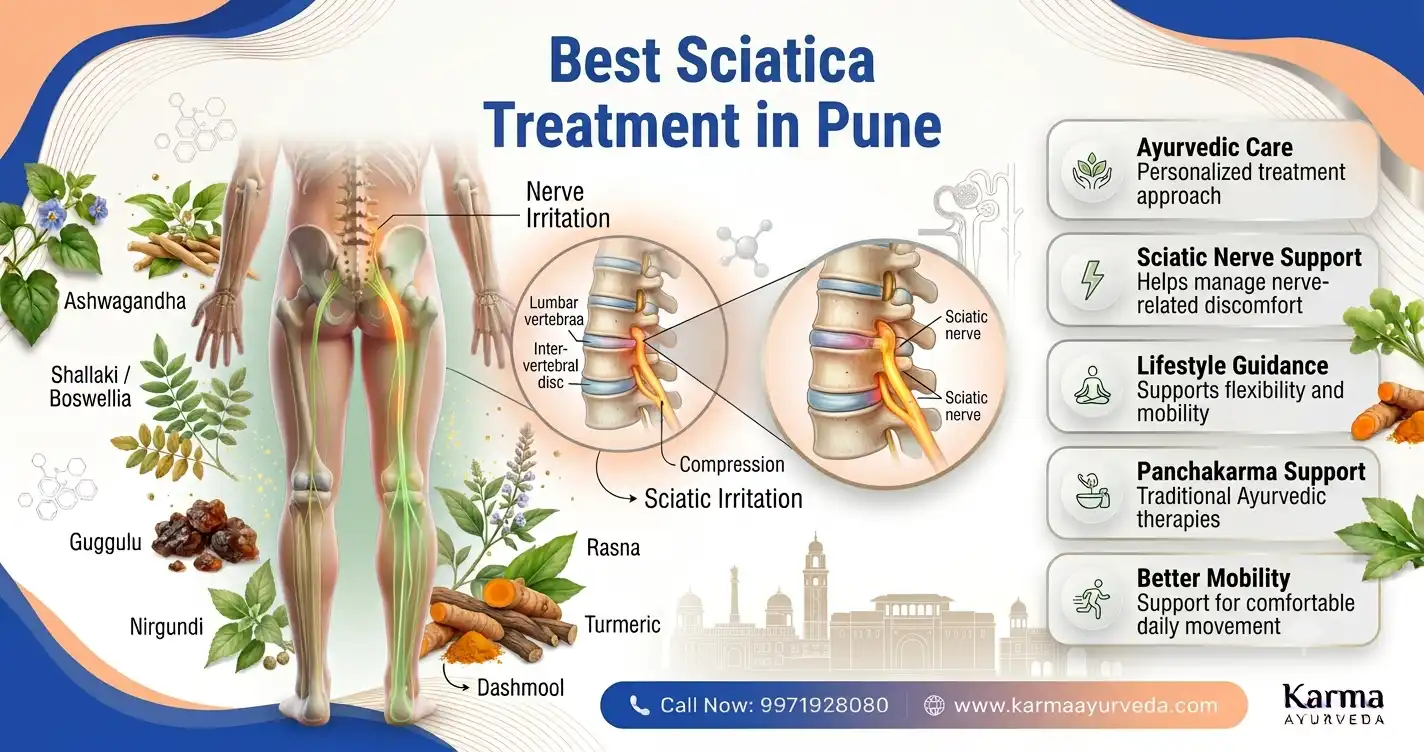
Sciatica happens when your sciatic nerve; the longest nerve in your body, running from your lower back all the way down to your toes; gets compressed, irritated, or generally annoyed. The result? Pain that radiates from your lower back through your hip, buttock, and down one leg, sometimes accompanied by numbness, tingling, or that lovely "pins and needles" sensation.
A widely cited review in the journal Spine (Konstantinou & Dunn, 2008) found that sciatica affects a notable chunk of the adult population at some point in their lives, with prevalence estimates ranging from about 1.6% to over 40% depending on how it's defined; basically, it's way more common than people assume, and definitely not something you should just "push through."
Common culprits include:
- Herniated or slipped discs (the most frequent troublemaker)
- Spinal stenosis (narrowing of the spinal canal)
- Piriformis syndrome (a muscle deep in your glutes deciding to be dramatic)
- Prolonged sitting, poor posture, or sudden awkward movements
- Excess weight putting pressure on the spine
Sciatica vs Muscle Pain: How Do You Even Tell the Difference?
This is where most people get confused, and honestly, fair enough; both can hurt like nobody's business. But sciatica vs muscle pain actually have pretty distinct personalities once you know what to look for.
Feature: Pain location
Sciatica: Radiates from lower back down one leg, often past the knee.
Regular Muscle Pain: Usually stays localized (like just your lower back or one shoulder).
Feature: Sensation
Sciatica: Sharp, burning, electric-shock-like, plus numbness or tingling.
Regular Muscle Pain: Dull, achy, sore; the "I overdid it at the gym" kind of pain.
Feature: Trigger
Sciatica: Worsens with sitting, coughing, or sneezing.
Regular Muscle Pain: Worsens with movement or pressing on the sore spot.
Feature: One side or both?
Sciatica: Almost always one side.
Regular Muscle Pain: Can be either.
Feature: Recovery time
Sciatica: May need weeks and targeted treatment.
Regular Muscle Pain: Usually settles in a few days with rest.
If your pain is shooting down your leg like it's got somewhere urgent to be, that's your sciatic nerve talking. If it's just a grumpy muscle, it'll usually calm down with rest and a hot water bag.
Ayurvedic Treatment for Sciatica: The Old-School Approach That's Making a Comeback
Here's the thing about Sciatica Ayurvedic treatment; it's not some trendy new wellness fad. Ayurveda has been dealing with this exact condition, called "Gridhrasi," for centuries, and modern clinical studies are actually backing up a lot of what the old texts said.
A prospective clinical study published in the International Journal of Research in Medical Sciences (Kaser et al., 2026) evaluated an Ayurvedic treatment protocol involving herbal formulations, kati basti (a warm oil pooling therapy over the lower back), and patra pinda sweda (herbal leaf poultice massage) in patients with gridhrasi. The result? Patients showed real, measurable improvement in both pain and function, leading the researchers to note that Ayurveda-based interventions could be a safe complementary strategy for managing sciatica.
Separately, a case report published in the Journal of Ayurveda Integrated Medical Sciences (2022) combined Ayurvedic panchakarma therapies with physiotherapy exercises, and the patient's pain score dropped from an 8 to a 0 on the standard pain rating scale within four weeks. That's not a small deal.
Typical elements of Ayurvedic sciatica treatment include:
- Kati Basti: Warm medicated oil is pooled in a dam-like ring on your lower back; sounds odd, feels amazing.
- Panchakarma therapies: Detox and purification treatments tailored to your dosha imbalance.
- Herbal internal medicines: Formulations aimed at reducing inflammation and calming the aggravated Vata dosha (Ayurveda blames most nerve pain on Vata going rogue).
- Basti (medicated enema): Sounds intimidating, but it's a classical treatment specifically recommended for Vata disorders like sciatica.
If you're in the city and looking around, several established Ayurvedic centers offer structured sciatica protocols; Karma Ayurveda for Sciatica treatment is one such option people often mention, typically combining herbal medication with therapies like basti and external oil treatments. As always, it's worth having a proper consultation before committing to any protocol, since sciatica causes can vary quite a bit from person to person.
Best Ayurvedic Oils for Sciatica (Because Yes, the Oil Matters)
Not all oils are created equal here, and slathering on any random mustard oil from your kitchen isn't going to cut it (sorry, but your grandmother's home remedy needs an upgrade). The best Ayurvedic oils for sciatica typically include:
- Mahanarayan Taila: A classic go-to for joint and nerve pain, often used in massage.
- Vishagarbha Taila: Known for its warming, penetrating action on deep-seated pain.
- Ksheerabala Taila: Milk-based medicated oil, gentle yet effective for nerve-related issues.
- Dhanwantharam Taila: A well-rounded oil often used post-Panchakarma for strengthening.
These are usually applied with gentle, warm massage (never on an acute inflamed area with vigorous pressure; that's a rookie mistake) followed by mild fomentation to help the oil penetrate deeper.
Sciatica Home Treatment: What You Can Do Without Leaving Your Couch
Look, not every twinge needs a clinic visit on day one. There's plenty you can try for sciatica home treatment before things escalate:
- Gentle stretching: Piriformis stretches and knee-to-chest stretches can work wonders. Yoga poses like Supta Padangusthasana are commonly recommended.
- Hot and cold therapy: Ice for the first 48-72 hours to calm inflammation, then heat to relax muscles.
- Fix your sitting posture: If your job has you glued to a chair (looking at you, Pune's IT crowd), get up every 30-40 minutes. Your sciatic nerve will thank you.
- Sleep smart: Sleeping on your side with a pillow between your knees takes pressure off the lower back.
- Stay gently active: Complete bed rest actually delays recovery; a landmark study in the New England Journal of Medicine (Peul et al., 2007) comparing surgery versus prolonged conservative treatment found that most patients improved significantly over time with non-surgical management, though those choosing early surgery got faster relief in the short term.
- Avoid heavy lifting: This isn't the time to prove your gym gains.
When Should You Actually See a Doctor?
Home remedies and Ayurveda are great, but let's not play hero if:
- The pain is so severe you can't sit, stand, or sleep.
- You notice weakness in your leg or foot.
- There's numbness in your groin or inner thighs, or loss of bladder/bowel control (this one's a genuine emergency; go straight to a hospital).
- Symptoms persist beyond 4-6 weeks despite home care.
Key Takeaways
- Sciatica is nerve pain that radiates from the lower back down one leg; not just a regular backache.
- Sciatica vs muscle pain: sciatica is sharp, radiating, and one-sided; muscle pain is dull and localized.
- Ayurvedic treatment for sciatica like kati basti, panchakarma, and herbal medicines have shown measurable improvement in clinical studies.
- Best Ayurvedic oils for sciatica include Mahanarayan, Vishagarbha, and Ksheerabala taila.
- Simple sciatica home treatment steps; stretching, posture correction, hot/cold therapy; go a long way.
- Complete bed rest isn't the answer; gentle movement supports faster recovery.
- Seek urgent medical help if you notice leg weakness, numbness in sensitive areas, or loss of bladder control.
Frequently Asked Questions
Q1. What is the fastest home remedy for sciatica pain?
Alternating hot and cold packs on the lower back, paired with gentle knee-to-chest stretches, usually brings the quickest relief at home.
Q2. Is Ayurvedic treatment effective for sciatica, or is it just placebo?
Clinical studies, including one published in the International Journal of Research in Medical Sciences, have shown real, measurable improvement in pain and mobility with structured Ayurvedic protocols.
Q3. How can I tell if it's sciatica or just a pulled muscle?
If the pain shoots down one leg past your knee along with tingling or numbness, it's likely sciatica; if it stays put in one sore spot, it's probably just a muscle strain.
Q4. Which Ayurvedic oil is best for sciatica massage?
Mahanarayan Taila and Vishagarbha Taila are among the most commonly recommended oils for sciatic nerve pain relief.
Q5. Can sciatica go away completely without surgery?
Yes, most people recover well with conservative treatment like Ayurveda, physiotherapy, and lifestyle changes, with surgery reserved only for severe or non-responsive cases.
Disclaimer
This blog is for general informational purposes only and isn't a substitute for professional medical advice, diagnosis, or treatment. Sciatica causes and severity vary from person to person, so please consult a qualified doctor or Ayurvedic practitioner before starting any treatment, especially if your symptoms are severe or persistent.