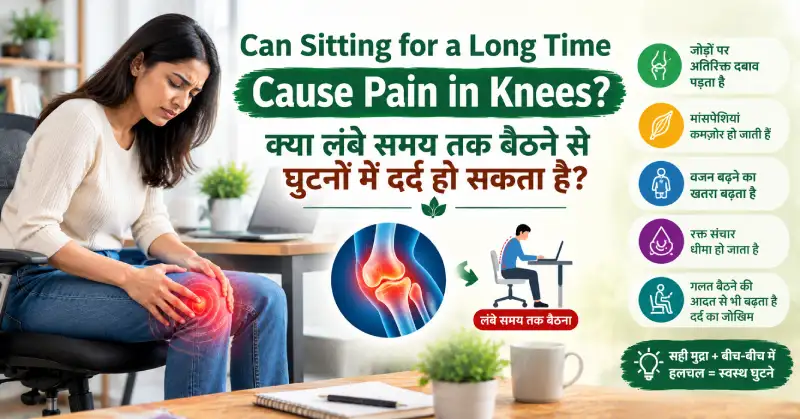
Can sitting for a long time cause pain in knees?
Yes, it can. It's not in a dramatic way but slowly. It causes stiffness and weaker muscles and a joint that gets grumpier with age. However, some best habits for healthy knees can eliminate a lot of damage.
Let's be honest; most of us spend their days mostly sitting on a chair and feel surprised why they stand up sounding like a bowl of cereal. Let's deal with this situation, learn what makes us do it and how we can avoid it.
What Makes Sitting Irritating for Your Joints?
Since your joint cartilage doesn't have blood supply, it uses nutrients from the synovial fluid which circulates only during movements. Thus, when you sit for hours, your joint is like a plant that is not watered.
The research data provides evidence for this thesis. In particular, a study conducted by Dunlop et al. in 2015 within the framework of Osteoarthritis Initiative demonstrated that older individuals who had spent a large amount of time sitting experienced a greater difficulty in performing everyday activities. The systematic review by Fransen et al. in 2015 showed that regular exercise reduces knee pain and increases functionality in individuals suffering from knee osteoarthritis.
Long sitting sessions have a number of drawbacks:
- Tighten your hamstrings and hip flexors that pull on the joint.
- Weakens your quadriceps and glutes (built-in shock absorbers)
- Bend the joint and keep it bent so long that it will complain when you straighten it
- Make the person gain more weight, thus adding load on every step
Sitting vs. Standing: A Candid Comparison
What Is Happening?
Sitting All Day Long | Doing Some Regular Movements
Joint fluid | Stagnant, like a forgotten pond | Flowing, like a happy river
Thigh muscles | Napping | Awake and supportive
Morning stiffness | More frequent, with sounds | A lot less drama
Move It: The Best Exercises for Knee Patients
You do not need a gym membership or some intimidating fitness guru. The best exercises for patients with knee problem are simple, non-impact, and weirdly dull (which can be taken as a compliment):
- Straight leg raises to stimulate the quadriceps.
- Glute bridges to make your hips and thighs stronger
- Hamstring stretches to relax tightness in the back of the legs
- stationary cycling or swimming for joint-friendly cardio
According to the 2019 guidelines from the American College of Rheumatology and Arthritis Foundation (Kolasinski et al.), exercise is highly recommended for patients with knee pain and osteoarthritis. So, your doctor asking you to walk more is a valid suggestion based on scientific evidence.
Easy Home Tips for Healthy Knees
No gadgets needed, here are simple, affordable home tips to get healthy knees:
- Set a timer and stand up every 30 minutes (stretch like a cat, no shame)
- Put your feet on the floor and adjust chair height to achieve comfortable position
- Avoid crossing your legs for hours
- Treat the condition with a warm compress on those days when it is rigid.
- You should pay attention to your weight as the IDEA trial (Messier et al., 2013) showed that weight loss plus exercise helped to alleviate pain and increase mobility in overweight adults with arthritis
The Ayurvedic Option
Ayurveda considers problems with joints an imbalance often associated with the aggravation of Vata. Ayurveda attempts to correct this imbalance with the help of diet, herbs, oils, and lifestyle changes. When it comes to knee pain Ayurveda treatment, the following are the most common herbs for knee pain treatment.
- Shallaki (Boswellia): A trial conducted by Sengupta and his colleagues in 2008 showed that taking Boswellia serrata extract helped to alleviate pain and stiffness in patients with osteoarthritis.
- Guggul, Nirgundi and Ashwagandha: traditional herbs, which have been used for years to reduce joint pains and inflammations.
In 2013, Chopra and others published a paper in Rheumatology indicating that an Ayurvedic formulation performs similarly to glucosamine and celecoxib in the treatment of symptomatic joint osteoarthritis. Although it is a promising finding, this is not a reason to give up going to see your doctor.
Wrapping it up
So, can your chair be really evil? Yes, it can. The key is your movement. Taking short breaks for moving your body and treating your joints well can help them work properly.
If you want personalized treatment, you can turn to specialists such as Dr. Puneet Dhawan, who works with Ayurvedic principles, or Karma Ayurveda for knee pain treatment.
Key Takeaways
- Long sitting can stiffen joints and weaken the muscles that protect them
- Cartilage needs movement to get its nutrients
- Stand and stretch every 30 minutes
- Low-impact exercise is backed by large reviews and guidelines
- Ayurvedic herbs for knee pain treatment show promise, but check with a professional first
FAQs
Can sitting too much cause knee pain?
Yes, because stiff joints and sleepy muscles make your legs less happy over time.
How often should I get up from my desk?
About every 30 minutes, even if it's just a stretch and a dramatic sigh.
Is walking good for sore joints?
Usually yes, gentle walking keeps joint fluid moving, though stop if the pain spikes.
Do Ayurvedic herbs really help joint discomfort?
Some, like Boswellia, have early research behind them, but results vary person to person.
Does sitting cross-legged ruin your joints?
Occasionally is fine, but hours on end can strain them, so switch positions often.
Disclaimer
This blog is for general information only and isn't a substitute for professional medical advice, diagnosis or treatment. Please consult a qualified doctor before starting any exercise routine, herbal remedy or treatment, especially if you have ongoing pain, swelling or an existing health condition.