Unlocking Wellness Naturally
100% Ayurvedic Treatment

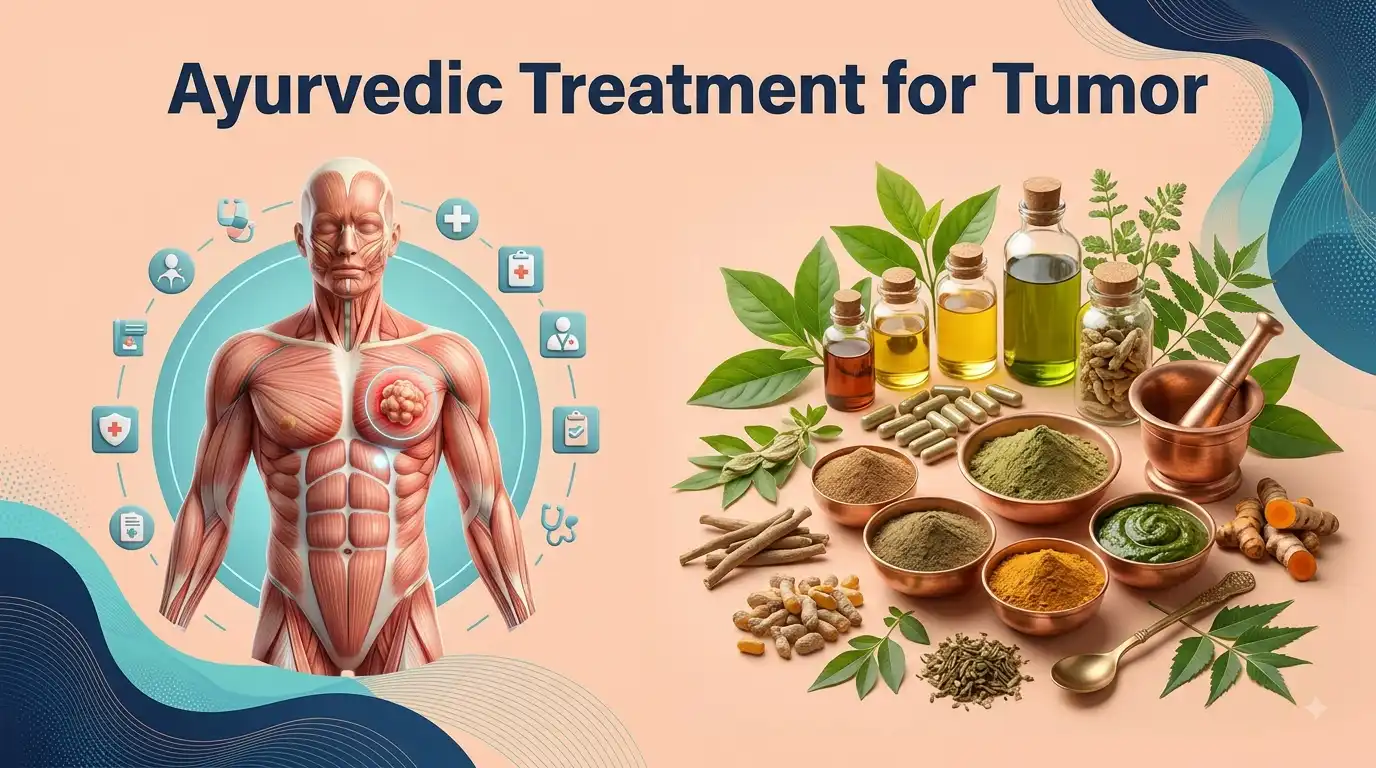
Ayurvedic treatment for tumor may be used as a complementary approach for overall wellbeing, symptom support, and lifestyle management, but it should not replace proper diagnosis or evidence-based cancer treatment. The right approach depends heavily on whether the growth is benign or malignant, where it is located, and what the medical reports show.
And yes, the word tumor can sound frightening. But a tumor is not automatically cancer. Some are benign, some are malignant, and some simply need monitoring. So before reaching for a cupboard full of herbs, the first step is knowing exactly what you are dealing with.
A tumor is an abnormal mass of cells that develops when cells grow or divide more than they should, or fail to die when they normally would. Tumors can occur in almost any part of the body.
Broadly, they are divided into:
That distinction matters enormously. A lump, swelling, or mass should not be labelled as cancer based on appearance alone. Imaging, laboratory tests, biopsy, and other investigations may be needed.
The World Health Organization emphasizes that an accurate diagnosis and staging are essential because cancer treatment depends on the specific type and stage. ([World Health Organization])
This is where honesty matters more than marketing.
An Ayurvedic treatment tumor approach may focus on supporting digestion, nutrition, strength, stress management, sleep, and general wellbeing alongside appropriate medical care. Ayurveda also uses individualized herbs and traditional therapies, depending on the person's overall condition.
However, there is currently not enough high-quality clinical evidence to say that Ayurvedic therapies can independently eliminate malignant tumors or cure cancer.
That does not mean every Ayurvedic herb is useless. It simply means laboratory findings and early clinical research should not be presented as proof of a cure. That's a pretty important difference; and one worth putting in giant imaginary capital letters.
The WHO supports the responsible integration of traditional and complementary medicine when it is evidence-based, safe, regulated, and appropriately integrated with healthcare systems. ([World Health Organization])
People often search for the best herbs for tumor management, but there isn't one universal herb that works for every growth.
Some plants and compounds have attracted scientific interest, including:
The important word here is research. A substance showing activity in a laboratory does not automatically mean it will shrink a tumor in a person.
For example, the systematic review Exploring the Contribution of Curcumin to Cancer Therapy examined randomized controlled trials and found that the available clinical evidence was not strong enough to recommend curcumin as a cancer treatment. ([PubMed])
A newer 2025 systematic review of 34 randomized trials involving 2,580 patients also found promising findings for issues such as oral mucositis and weight loss, but concluded that the evidence was too heterogeneous and methodologically limited to establish curcumin's effectiveness against cancer itself. ([PubMed])
So, the best herbs for tumor support are not necessarily the ones making the loudest claims online. They are the ones selected appropriately, checked for safety, and used with professional guidance.
There is no single list of best medicines for tumor because treatment depends on the diagnosis.
For malignant disease, treatment may involve:
The right combination depends on the cancer type, location, stage, genetic characteristics, overall health, and previous treatments.
Ayurvedic medicines may sometimes be considered as complementary support, but they should be reviewed by the treating medical team because herbs can interact with medicines or affect treatment decisions.
A 2023 review titled Integrating Ayurvedic Medicine into Cancer Research Programs specifically highlighted the need for stronger evidence and stated that Ayurvedic approaches should not be considered substitutes for established cancer treatment. ([IMSEAR])
An individualized Ayurvedic treatment tumor plan may look beyond the mass itself and consider the person's overall condition.
Depending on the diagnosis, a practitioner may discuss:
This is also where personalized care matters. The same herb that sounds wonderful in a blog may be completely inappropriate for someone taking certain medicines.
At Karma Ayurveda Hospital, the approach described by the organization includes reviewing a patient's symptoms, medical history, reports, diet, and overall health before suggesting an individualized plan. Dr. Puneet Dhawan is identified by the hospital as its current clinical leader.
The sensible takeaway is not that one treatment works for everybody. Quite the opposite.
A person's diagnosis, medications, nutritional status, and treatment history all matter. If someone is already undergoing chemotherapy, radiation, immunotherapy, or surgery, their oncology team should know about every supplement or herbal product being considered.
Because "natural" is not a synonym for "cannot interact with medicines." Poison ivy is natural too. Nature did not promise a user manual.
The phrase best medicines for tumor sounds straightforward, but medicine rarely works like choosing the "best" item from a shopping list.
For example, two people can have tumors in the same organ but receive completely different treatments because their tumor types, stages, biomarkers, or general health are different.
Similarly, Ayurvedic formulations should not be selected solely because they contain a popular herb. Product quality, dosage, interactions, contamination, and the person's medical condition all deserve attention.
WHO's benchmarks for Ayurveda emphasize requirements around safety, quality assurance, regulation, ethical practice, and appropriate use of Ayurvedic interventions. ([World Health Organization])
The scientific picture is interesting; but still incomplete.
Curcumin is probably one of the most researched plant compounds in this area. Laboratory studies have explored its effects on inflammation, cell signaling, angiogenesis, and other biological pathways. Human research, however, has produced mixed findings.
The systematic review Clinical Effects of Curcumin in Enhancing Cancer Therapy reported potential benefits in some studies, particularly concerning treatment-related side effects, but these findings should not be interpreted as proof that curcumin itself cures cancer. ([PubMed])
Another critical analysis, Clinical Trials on Curcumin in Relation to Its Bioavailability and Effect on Malignant Diseases, also highlighted a major scientific headache: curcumin has very low bioavailability, meaning the body does not simply absorb large amounts of it because someone took a capsule. ([PubMed])
This is why more large, well-designed human trials are still needed.
It can be considered as a complementary wellness approach, particularly when the goal is supporting nutrition, daily wellbeing, stress management, and quality of life.
But Ayurvedic treatment for tumor should not mean delaying a biopsy, skipping an oncologist, stopping chemotherapy, or replacing surgery when surgery is medically recommended.
The safest approach is an integrated one: understand the diagnosis first, follow evidence-based treatment recommendations, and discuss any Ayurvedic herbs or therapies with the healthcare professionals involved in your care.
And if someone promises that a particular herb will "melt away" every tumor, keep your wallet; and your eyebrows; raised.
There is growing scientific interest in Ayurveda and plant-derived compounds, but research is still developing. Some herbs have interesting biological properties, yet that is very different from proving that they can cure malignant disease.
The most responsible Ayurvedic treatment for tumor approach is therefore one that respects both traditional knowledge and modern medical evidence. Get the growth properly diagnosed, understand the treatment options, and use complementary therapies only when they are appropriate and safely coordinated.
There is currently insufficient clinical evidence to say that Ayurvedic treatment alone can cure malignant tumors.
Turmeric/curcumin and several other herbs are being researched, but no herb has been proven to universally treat or cure tumors.
Sometimes complementary products may be considered, but they should first be discussed with the treating oncologist because interactions are possible.
No, many tumors are benign and do not behave like cancer.
There is no universal answer; treatment depends on the tumor's type, stage, location, and individual medical factors.
This article is for general educational purposes and should not be treated as medical advice. Ayurvedic herbs or therapies should not replace biopsy, oncology consultation, surgery, chemotherapy, radiation, or other medically recommended care. Always discuss supplements and complementary treatments with your qualified healthcare team before use.
Continue using AI Cursor?Keep it onTurn Off

AyuKarma Testo Build Capsules combine 12 Ayurvedic herbs and minerals to support strength, energy, stamina, physical performance, nourishment and overall daily vitality.

AyuKarma Hair Lush Capsules combine Ayurvedic herbs to support hair growth, reduce hair fall, strengthen roots, nourish the scalp and promote healthier-looking hair.

Karma Garcom Capsules contain Garcinia indica to support healthy metabolism, digestion, weight management, digestive comfort and daily wellness alongside a balanced lifestyle.

Doctor-recommended liver supplement that helps detoxify the liver, support healthy cholesterol, improve digestion & promote liver health. Developed by Dr. Puneet Dhawan with Karma Ayurveda philosophy.

AyuKarma Muscle Magic Capsules combine Ayurvedic herbs to support appetite, digestion, nourishment, healthy weight gain, muscle strength and daily vitality for adults.

AyuKarma Obes-Fit Capsules combine Ayurvedic herbs to support appetite control, digestion, metabolism, healthy weight management, energy and overall wellness alongside an active lifestyle.

AyuKarma Body Detox Capsules combine Ayurvedic herbs to support natural detoxification, digestion, colon cleansing, metabolism, gut wellness and overall rejuvenation for daily vitality.

Doctor-recommended ayurvedic medicine to control diabetes, manage blood sugar levels & reduce diabetes-related complications in diabetic patients. Developed by Dr. Puneet Dhawan with the Karma Ayurveda philosophy.

Doctor-recommended Ayurvedic gut supplement that helps relieve occasional constipation, promote smooth bowel movement, reduce gas & bloating and improve digestion. Developed by Dr. Puneet Dhawan with Karma Ayurveda philosophy.

Doctor-recommended Ayurvedic joint supplement that helps relieve joint pain & stiffness, improve flexibility and support smoother, more comfortable movement. Developed by Dr. Puneet Dhawan with Karma Ayurveda philosophy.

Ayurvedic Kidney Detox Kit for individuals with high creatinine, high BP, diabetes, high uric acid, alcohol consumption habits, frequent painkiller use or early signs of kidney stress.
Second Floor, 77, Block C, Tarun Enclave, Pitampura, New Delhi, Delhi, 110034

Certificate no- AH-2023-0186
JAN 05, 2026 - JAN 04, 2029

US FDA Reg. No.: 14568299376