If You Have Knee Pain, Is Sitting on the Floor Safe?
Yes, you can sometimes sit on the floor even with knee pain; but it really depends on how much you're bending your knees, how long you stay down there, and what's actually causing the pain in the first place. If getting down feels fine but getting back up feels like your knees have filed a formal complaint, that's a sign to modify the position rather than just push through it.
For a lot of Indian families, sitting on the floor isn't exactly optional. Meals, prayers, conversations, festivals, and occasionally hunting for the TV remote under the sofa; all of it can mean getting down there. But when your knees are already hurting, deep bending can get uncomfortable fast.
So is floor sitting actually bad for painful knees? Not automatically. The bigger question is how your specific knees respond to that position.
What Happens to Your Knees When You Sit on the Floor?
Floor sitting generally requires a lot more knee bending than sitting on a chair.
Depending on the position, your knees might stay in deep flexion for several minutes at a stretch. Squatting, kneeling, cross-legged sitting, and sitting with your legs folded underneath you all place very different demands on the knee joint.
Research on deep knee flexion shows that activities like squatting, kneeling, and lunging can push knee flexion beyond 120 degrees. A 2018 systematic review published in The Knee looked at the biomechanics of these positions in healthy knees and found measurable changes in joint movement and loading during deep flexion.
That doesn't mean deep bending automatically damages your joints. It just means a painful or stiff knee may not tolerate the same movement as comfortably as a healthy one. And that's exactly where individual differences come into play.
So, When Is Sitting on the Floor Usually Okay?
If you have mild knee discomfort and can sit down and stand up without significant pain, swelling, instability, or stiffness afterward, occasional floor sitting is probably manageable.
A useful rule of thumb: if the position feels comfortable during the activity, and your symptoms don't noticeably flare up afterward, your knees are likely tolerating it reasonably well.
But don't turn this into a competition with yourself. You don't win a medal for sitting cross-legged for two hours just because everyone else at the table is doing it.
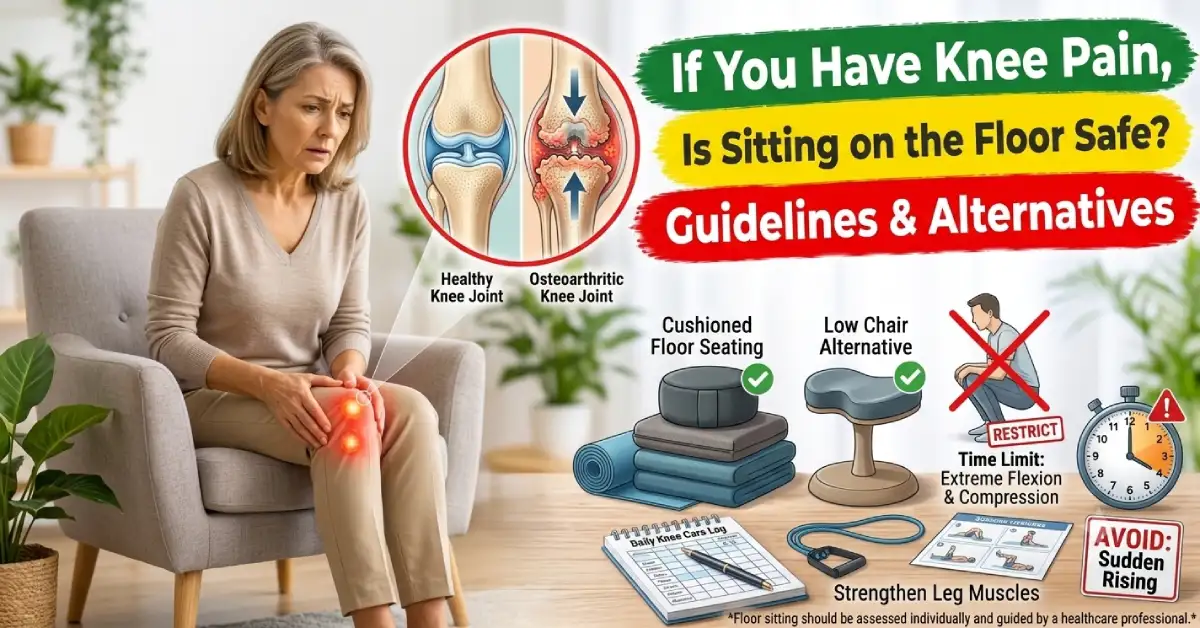
Consider slipping a folded blanket or cushion under your hips; it can make the position more comfortable and reduce how deeply your knees actually need to bend. You can also shift positions every 15–30 minutes instead of staying frozen in one posture the whole time.
When Should You Avoid Sitting on the Floor?
Floor sitting deserves more caution if you're already dealing with significant pain or restricted movement.
Be particularly careful if you notice:
- Sharp pain while bending the knee
- Noticeable swelling
- Knee locking or catching
- A feeling that the knee might give way
- Real stiffness after sitting
- Trouble getting back up
- Pain that stays worse for hours afterward
- A recent knee injury or surgery
For people with osteoarthritis, deep flexion can be especially uncomfortable, since the available range of movement is often already reduced. A recent systematic review and meta-analysis found that people with symptomatic knee osteoarthritis had reduced knee flexion and extension compared to healthy people, with the limitations getting worse in more advanced disease.
In other words; if your knee already has less room to move, forcing it into a deeply folded position isn't necessarily the cleverest idea.
What About Cross-Legged Sitting?
Cross-legged sitting is probably the first position most people picture when they hear "sit on the floor."
For some people, it's perfectly comfortable. For others, it creates pressure, stiffness, or aching right around the knees.
The important thing isn't whether cross-legged sitting is universally "good" or "bad"; it's really about your symptoms, flexibility, strength, and joint condition specifically.
Worth trying:
- Sit on a cushion.
- Keep your hips slightly higher than your knees.
- Don't force the knees downward.
- Change position regularly.
- Use a chair when getting up starts feeling difficult.
If your knee starts complaining, listen to it. It doesn't need to shout before you pay attention.
What If Your Knees Make a Crackling Sound?
This is another thing people worry about a lot.
You bend your knee. You hear crrrk. You stop. You stare at your knee. Your knee, for its part, remains completely uninterested in explaining itself.
A knees crackling sound can happen for several reasons; changes in joint movement, gas bubbles, tissues shifting around the joint. On its own, the sound doesn't necessarily mean arthritis or serious damage.
That said, if the knees crackling sound comes paired with persistent pain, swelling, locking, or reduced movement, it's worth getting checked out. The sound itself matters a lot less than whatever symptoms are showing up alongside it.
Why Getting Up From the Floor Can Be Harder Than Sitting Down
Interestingly, the bigger challenge often isn't sitting down; it's standing back up.
Getting from the floor to standing needs coordinated movement across the knees, hips, and surrounding muscles. People with knee osteoarthritis often naturally shift their movement strategy while doing sit-to-stand movements without even realizing it.
A systematic review and meta-analysis published in the Journal of Biomechanics looked at sit-to-stand movement in people with knee osteoarthritis and found differences in movement mechanics compared to people without the condition; though the authors flagged that the evidence quality was very low, so the findings should be taken cautiously.
This is exactly why strengthening the muscles around the joint tends to be more useful than just worrying about whether or not you're sitting on the floor.
Floor Sitting vs Chair Sitting: Which Is Easier?
Here's the practical breakdown:
| Situation | Floor sitting | Chair sitting |
|---|---|---|
| Deep knee bending | Higher | Lower |
| Getting up | Can be challenging | Usually easier |
| Changing position | Important | Easier |
| Painful/stiff knees | May need modification | Often more comfortable |
| Long sitting | Breaks are still needed | Breaks are still needed |
Neither option is automatically perfect. The best sitting position is usually just whichever one lets you stay comfortable without forcing painful movement.
What Can You Do Instead of Forcing Floor Sitting?
If floor sitting hurts, you don't have to give up every activity you enjoy. Try these simple modifications:
- Use a firm cushion; raising your hips reduces how deep your knees need to bend.
- Keep sessions shorter; get up, walk around, and change position regularly.
- Use a low stool; you stay close to the floor without folding your knees all the way.
- Strengthen gradually; exercises recommended by a physiotherapist can genuinely improve function.
- Avoid sudden movements; lower yourself slowly and use support when standing.
- Don't ignore swelling; persistent swelling deserves a proper professional look.
The 2019 American College of Rheumatology/Arthritis Foundation guideline recommends exercise as a key part of managing knee osteoarthritis, alongside things like weight management where appropriate and general self-management strategies. The Osteoarthritis Research Society International (OARSI) also offers evidence-informed recommendations for non-surgical management of knee, hip, and polyarticular osteoarthritis.
What About Natural Approaches for Knee Pain?
People often go looking for Natural arthritis treatment when they'd rather manage discomfort without jumping straight to medication.
That might include appropriate physical activity, weight management, sleep, nutrition, physiotherapy, and select traditional approaches used together.
If you're researching best herbs for arthritis, remember that "natural" doesn't automatically mean suitable for everyone. Herbs can interact with medicines, and the evidence varies a lot from one herb to the next.
Similarly, searching for the best medicines for knee pain can be a bit misleading, because the right treatment really depends on what's causing the pain, other health conditions, current medications, and severity. What works well for one person might not be right at all for someone else.
If someone's exploring Natural arthritis treatment, it's worth discussing the approach with a qualified healthcare professional like Dr. Puneet Dhawan, especially if they're already on medication.
Can Ayurveda Help With Knee Pain?
Ayurvedic approaches may involve dietary changes, lifestyle practices, movement, massage-based therapies, and herbal preparations, depending on the individual.
Some people specifically look into Karma Ayurveda for arthritis treatment while exploring traditional approaches for joint discomfort. That said, treatment really needs to be personalised. Persistent swelling, severe pain, a recent injury, fever, redness, or being unable to bear weight shouldn't be managed at home alone.
And if you're considering best herbs for arthritis, don't start stacking multiple herbal products at once just because the internet says they're popular. "More herbs" isn't the same thing as "more benefit."
When Should You See a Doctor?
Occasional discomfort after sitting on the floor isn't necessarily alarming on its own. But it's worth getting a professional evaluation if you have:
- Persistent or worsening pain
- Significant swelling
- Repeated locking or giving way
- Severe stiffness
- Trouble walking
- Pain following an injury
- Inability to put weight on the leg
- Fever with a hot, swollen joint
The goal isn't just to find the best medicines for knee pain. First, the actual reason behind the pain needs to be properly understood.
The Bottom Line
So, is sitting on the floor safe if you have knee pain? Sometimes, yes.
But don't force deep knee bending simply because sitting on the floor is part of your everyday routine. If you can sit comfortably, get up safely, and don't experience a prolonged flare-up of symptoms afterward, a modified floor-sitting position is often reasonable.
If your knees hurt every time you fold them, reach for a cushion, keep sessions shorter, or just use a chair instead.
And remember; hearing a knees crackling sound isn't automatically a reason to panic. Pain, swelling, instability, and loss of movement tell you a lot more about whether your joint actually needs attention.
Evidence-based exercise and self-management remain central to osteoarthritis care, while approaches like Natural arthritis treatment should be considered thoughtfully, alongside proper medical guidance rather than instead of it.
Key Takeaways
- Floor sitting isn't automatically harmful for people with knee pain.
- Deep bending can be uncomfortable when knee movement is already restricted.
- A cushion can make floor sitting easier by raising the hips.
- Change positions regularly rather than staying folded for long stretches.
- Pain, swelling, locking, or instability are far more important warning signs than joint sounds alone.
- Exercise and appropriate strengthening are important parts of osteoarthritis management.
- Don't choose treatments just because they're marketed as the best medicines for knee pain or the "best" natural option.
FAQs
Can I sit on the floor if I have knee arthritis?
Yes, if you can do it comfortably; just avoid forcing deep bending or staying in one position for too long.
Is sitting cross-legged bad for painful knees?
Not necessarily, but stop or modify the position if it causes pain, swelling, or lingering stiffness.
Does a knees crackling sound mean arthritis?
Not always; joint sounds can happen without any serious underlying disease, but pain or swelling alongside the sound is worth paying attention to.
What's the safest sitting position for knee pain?
A comfortable chair or a raised floor position is often easier when deep knee bending is triggering symptoms.
Can natural approaches help with arthritis?
Some lifestyle and traditional approaches can be useful, but they should be chosen based on the person's specific condition and medical needs.
Disclaimer
This article is for general educational purposes and shouldn't replace a medical examination or an individual treatment plan. Knee pain can have many causes, including arthritis, injury, and other joint problems. If symptoms are persistent, severe, or getting worse, consult a qualified healthcare professional for proper evaluation and treatment.